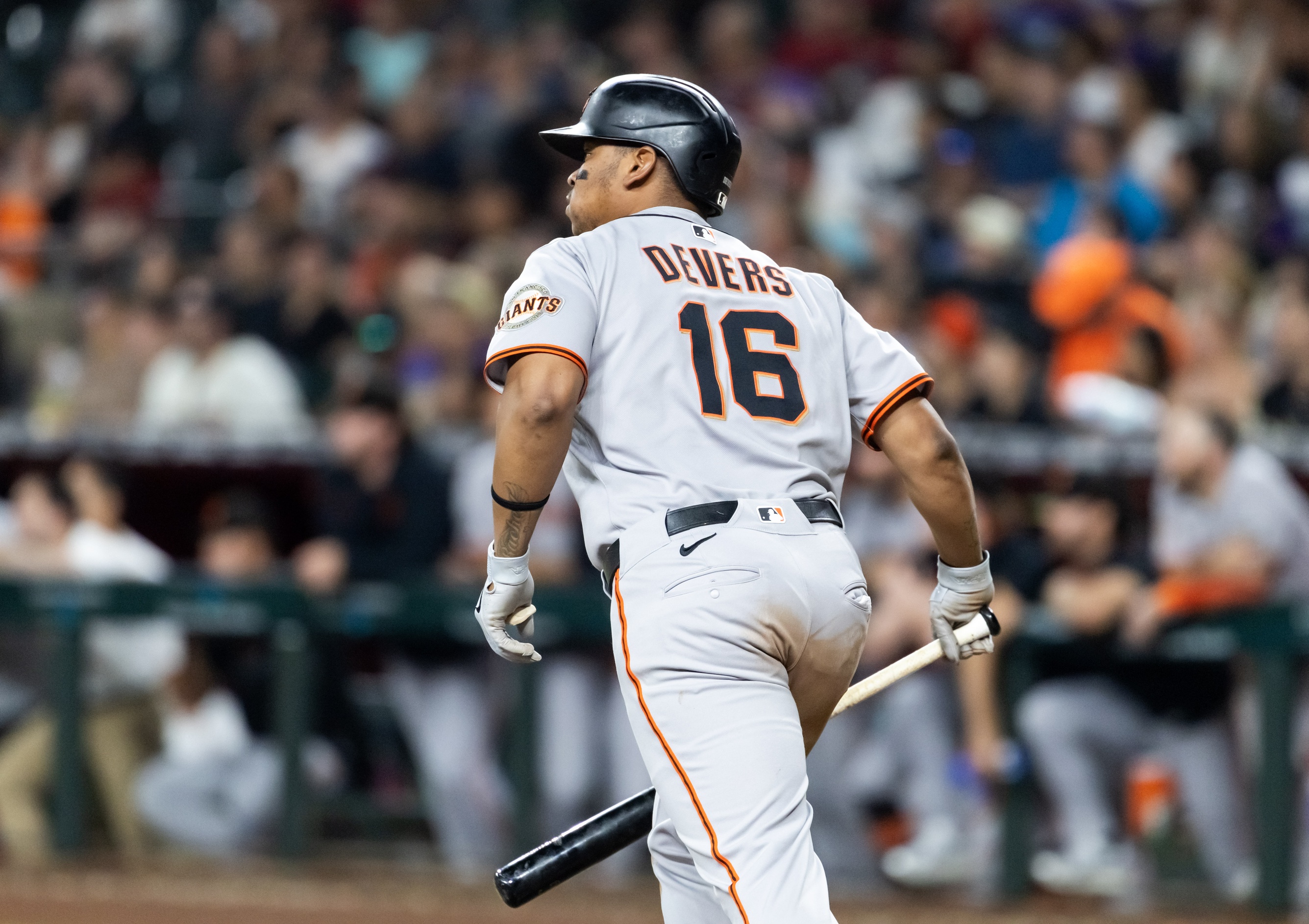

When the Red Sox front office or ownership group speaks, it often leaves more questions than answers. Fans have grown accustomed to long explanations about “organizational philosophy” and “long-term vision,” but rarely the kind of direct clarity they’re looking for.
On Sunday, chairman Tom Werner spoke and didn't disappoint as he revisited the Rafael Deverssaga that dominated the early part of last season.
“I don’t like to speak ill of any player. I’d like to say that he’s a wonderful person,” Werner told The Boston Globe. “But, of course, when we had an injury at first base, his unwillingness to play that position was extremely discouraging.”
The tension traces back to last spring, when the Red Sox signed Alex Bregmanat the start of camp. With Bregman taking over third base, Devers was informed he would move into a full-time designated hitter role. Initially, Devers pushed back publicly about shifting off his natural position, though he ultimately agreed to become the everyday DH.
The situation escalated when Boston later asked him to consider playing first base following a season-ending injury at the position — a request Devers declined. Werner’s comments on Sunday offered ownership’s clearest public acknowledgment of the standoff that ultimately played a significant role in how events unfolded prior to a Father's Day trade.
Blue bat power! 💥 pic.twitter.com/bl0aK0QElX— Red Sox (@RedSox) June 15, 2025
After a slow start, Devers began to find his rhythm at the plate. Then, just over a month into the season, Triston Casasruptured his patellar tendon and was lost for the year. With a sudden hole at first base, the Red Sox approached Devers about returning to the field and learning the position. He declined.
“It was a discouraging episode,” Werner said. “Just pick up a glove.”
Devers, however, had been clear about his frustration. After being told in spring training to put his glove away and focus solely on designated hitter duties following the signing of Bregman, he didn’t view the in-season request as reasonable.
“I know I’m a ballplayer but at the same time they can’t expect me to play every single position out there,” Devers said last year. “In spring training, they talked to me and basically told me to put away my glove — that I wasn’t going to play any other position but DH. So right now I just feel like it’s not an appropriate decision by them to ask me to play another position.”
Werner’s recent comments offer some insight into what may have been said behind closed doors when principal owner John Henry flew to Kansas City in May to meet with Devers following his public criticism of management. Chief baseball officer Craig Breslowlater described the meeting as “an honest conversation about what we value as an organization and what we believe is important to the Boston Red Sox.”
While Devers stood firm, Boston was left patching the position together, platooning Romy Gonzalez and Abraham Toro at first base to fill the void left by Casas.
Rafael Devers clubs a homer and it's all @RedSox in Cleveland 😮 pic.twitter.com/34VbfPkzJR— MLB (@MLB) April 27, 2025
“He expressed his feelings. John did the same thing,” manager Alex Corasaid at the time. “The most important thing here is we’re trying to accomplish something big. There are changes on the roster, situations that happen, and you have to adjust.”
One month later, following a three-game sweep of the Yankees at Fenway Park, the Red Sox pulled the trigger. Devers was traded to the Giants in a five-player deal, with San Francisco taking on the remainder of his contract.
In return, Boston received left-hander Kyle Harrison, hard-throwing righty Jordan Hicks, outfield prospect James Tibbs III, and right-handed pitching prospect Jose Bello.
Once in the Bay Area, Devers appeared in 17 games at first base for the Giants — the very position he declined to play in Boston. Devers taking reps at first base didn't go unnoticed by fans in New England and caused further frustration amongst the Fenway Faithful.
As the Red Sox enter spring training, they only have one player remaining from the blockbuster swap, trading Harrison to the Brewers in a multi-player deal for infielder Caleb Durbin, moving Hicks to the White Sox with David Sandlin in a salary dump, saving the Sox $8 million over the next two seasons, and they sent Tibbs III and another outfield prospect to the Dodgers for two months of Dustin Maylast season, who ultimately was shut down with an arm issue and then signed with the Cardinals this winter.
The players the Red Sox received for Rafael Devers last June: James Tibbs III- traded to Dodgers Jordan Hicks- traded to White Sox Kyle Harrison- traded to Brewers Jose Bello- 55.2 IP in Rookie Ball/Single-A in 2025 pic.twitter.com/3Ic0nIBE7m— Just Baseball (@JustBB_Media) February 9, 2026
Speaking of Bregman, Red Sox CEO Sam Kennedydidn’t mince words when he met with the Sox’ media on Sunday morning. Boston lost Bregman this offseason to a five-year, $175-million deal with the Cubs. The Red Sox reportedly offered a similar deal to Bregman’s camp but a no-trade clause was the tipping point for the veteran third baseman.
When asked on Sunday if not offering the no-trade clause was an organizational policy, Kennedy replied: “If Alex Bregman wanted to be here, ultimately, he’d be here.” He was asked again about the organization's policy on offering a no-trade clause to free agents and he wouldn’t further elaborate.
“We try not to talk about organizational policy and the finer points of negotiations,” he said. “Just doesn’t serve you well.” Kennedy maintained the same sentiment when asked if the Red Sox would have given Bregman a no-trade clause to get the deal done.
“It’s theoretical, right? It’s hard to know,” Kennedy said. “There’s many different parts of a contract negotiation. We did not come to an agreement. So obviously, he’s a Chicago Cub and wish him well until the end of the year.”
Boston spent all offseason pursuing a reunion with Bregman, who opted out of a three-year, $120 million deal he signed before spring training. The Red Sox reportedly offered a five-year, $165 million deal to Bregman who ultimately signed with the Cubs the night the Red Sox’ Fenway Fest came to a conclusion.
Alex Bregman comes up CLUTCH with a pinch-hit 3-run homer 😮 pic.twitter.com/H1yNreNLdx— MLB (@MLB) July 20, 2025
“We’re so grateful to Alex Bregman and what he meant to us,” Kennedy said Sunday. “But look, in the end, when you have choices the way he did, you work really hard to be in a position to become a free agent and perform at that level. He chose a different path, and we wish him well and looking forward to seeing him at the end of the season at Fenway (when the Cubs play the Red Sox Sept. 25-27).”
The Red Sox losing both Devers and Bregman is bad optics to a fanbase that has felt alienated by the front office and ownership since the Mookie Betts trade in 2020. Boston stated they’d reinvest the Devers’ money back into the team and in a way have, signing Ranger Suárez to a five-year, $130 million deal this offseason and traded for both Sonny Gray and Willson Contrerasfrom the Cardinals.
Fans wanted more, and rightfully s,o following a successful 2025 season that saw the Sox make the postseason for the first time since 2021.
“You can’t replace someone like Raffy as an individual, an exceptional hitter,” Kennedy said. “It’s an opportunity for guys to step up and generate offense. I think you know what we’re capable of with this outfield, but we’ll have to go out and do that.”
Boston may not have been able to fully replace Devers in a short window, but the club had opportunities to at least address the lost production. Free agent targets Pete Alonso ultimately signed with the division-rival Baltimore Orioles, while Kyle Schwarberreturned to the Philadelphia Phillies. Both would have added the kind of middle-of-the-order power the lineup now appears to lack.
Instead, Breslow and the front office pivoted, reinforcing a run-prevention model built around pitching depth and defensive improvement, highlighted by the addition of Suárez and other arms. It’s a philosophical shift — one that places less emphasis on replacing Devers’ bat directly and more on reshaping the team’s identity around run-prevention.
Red Sox fans and supporters want transparency from ownership and the front office. Say what you’re going to do and stick to it; avoiding another messy, drawn-out situation with a franchise cornerstone. With the young core’s competitive window open now, trust matters more than ever between the interoperation of fans as to how the team handles its players.
Rafael Devers hits a home run off Kyle Freeland, and now the benches have cleared in Colorado (via @NBCSGiants)pic.twitter.com/8L79T5Xouo— FOX Sports: MLB (@MLBONFOX) September 3, 2025
“We all have to do what’s in the best interest of the organization,” Kennedy said. “We have to make really hard decisions. And that trade was among the hardest in 25 years here. That was among the hardest. Would we have done things differently leading into it? Absolutely. Questioning ourselves — where did we make mistakes? What could we have done better?
“But at the end of the day, we were faced with a decision that was a hard one, and we made it. I’m really proud of everybody who worked together on that. Time will tell. We’ll see how the results are. But it was a tough decision.”
It’s not often the ownership group speaks, and on Sunday, Werner and Kennedy avoided the typical word salad that Breslow typically spews. Werner’s comments on Sunday had a different tone than what Red Sox fans have grown used to over the past several years. There was a bluntness to them — a willingness to say the quiet part out loud — that felt reminiscent of Larry Lucchinoin his prime. Lucchino never shied away from controversy, and whether you agreed with him or not, you always knew where he stood. That kind of directness hasn’t been common from the Boston Red Sox leadership group in a long time.
Meanwhile, Kennedy continued to lean into messaging that hasn’t landed well with much of the fan base. Framing the additions of Suárez, Contreras, and the acquisition of Gray as a way of reallocating Devers’ money may make sense on a balance sheet. It’s harder to sell emotionally to a fan base that watched a homegrown star leave.
Fans have heard the long-term vision before; in fact, for the last six years. They’ve heard about sustainability, flexibility, and strategic pivots. What they want now is wins in the regular season that lead to October baseball. Until that shows up consistently on the field, skepticism toward the front office — and ownership — isn’t going anywhere.