
BOSTON — The Boston Celtics entered Wednesday night’s game with an 8-14 record against the other nine top-10 teams in the NBA this season (in terms of record). Yet they managed to walk out 9-14.
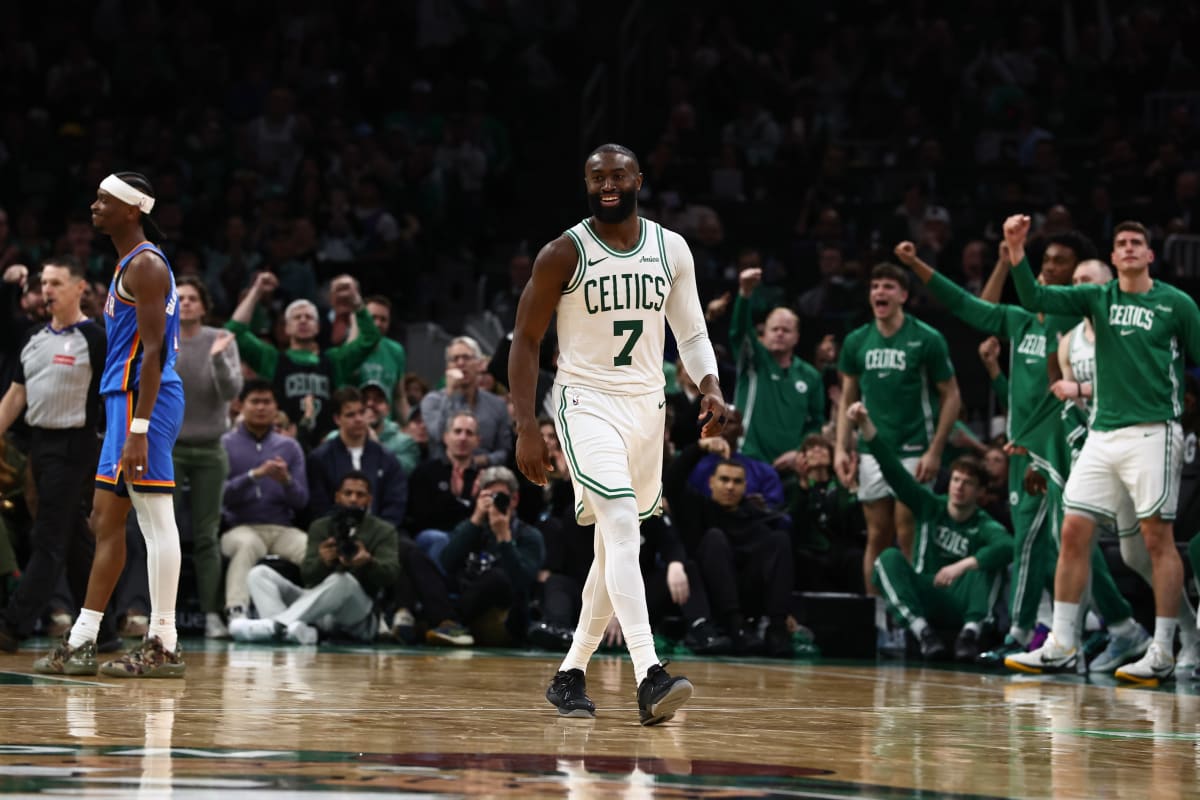
Led by Jaylen Brown’s 31 points, Boston clawed and scratched its way to a win, snapping the Oklahoma City Thunder’s 12-game win streak. The fully-healthy Thunder, to be exact.
It wasn’t a perfect performance. No performance ever is. But on Wednesday, it was enough, and that’s what matters.
But how did it all unfold?
1. Quick thinking
If beating the Thunder is the solar system, then this is the Sun. It’s at the center of everything. Without it, the Celtics would have wilted under the pressure of OKC’s defense.
Oftentimes, playing “fast” is associated with constant ball movement. Off-ball movement. Never stopping. But against the Thunder, in particular, that’s not necessarily the case.
It’s about slow vs. fast. It’s about hesitation vs. action.
Oklahoma City sends a lot of help on defense. On Wednesday night, almost every single time Brown or Jayson Tatumtouched the paint, the Thunder sent a help defender. However, when the Celtics were slow to make a decision, that help was far more effective.
Here’s an example. At every point in the play, the Celtics are just a half-second behind the Thunder. First, OKC closes the window for Derrick White to make the pass to Tatum, who is coming off a flare screen from Neemias Queta.
Then, Jalen Williams catches up to White, so Queta can’t hand the ball off. Then, Payton Pritchard doesn’t pass to Queta on the roll in time, because Isaiah Joewas showing help from the corner. Then, White doesn’t get the dump-in pass to Queta in the lane, and he ends up with an awkward shot at the rim.
Had the Celtics been a tiny bit quicker to make any of those decisions, or if they had run a half-step faster or zipped a pass a bit more, they could have ended up with a better shot. Those are the miniature battles in a possession where it's won or lost.
It’s a similar story in this play. Tatum gets a screen from Queta, but rather than continuing his drive (albeit into an awaiting Lu Dort) or finding a pass, he stops.
The Celtics have to reset, and then the opposite occurs.
As soon as White sees that he has a shred of space to drive on Shai Gilgeous-Alexander, he takes it. And since he took advantage of the small gap OKC gave him, Boston ends up with a good look at the rim.
Tatum picking up the ball here could have thrown a wrench in the entire possession.
As the first half unfolded, Tatum stopped the ball a few times at the top of the key. It wasn’t the concept of going one-on-one that was hurting the Celtics. It was the hesitation.
Boston’s offense fell into a few pockets of stagnation, which is a death sentence against the Thunder’s defense. Tatum improved as the game went on, matching the Celtics’ quick-thinking needs and following in the footsteps of Brown.
Brown’s unrelenting desire to act quickly was what helped him break down OKC’s defense on Wednesday night.
“They're very physical. So, if you don't own your space, if you don't fight to get open, set up your catches, none of that stuff, if you don't do that, they can make it a long night,” Brown said. “But I thought we did a good job of keeping our man between the ball and the basket, protecting it, getting the ball where we wanted to get the ball, initiating our offense when we wanted to initiate it, versus them dictating where we go. And I think that was the difference tonight.”
Look at this play. It doesn’t come across as particularly speedy or fast-paced, but it’s a pair of quick decisions made in tandem.
Brown waits for the screen from White, reads the defense, and reacts in an instant. As soon as he sees Gilgeous-Alexander swaying a bit too far to his right, he cuts in to the left.
This forces Dort to help, and Brown kicks the ball to White. And rather than holding it or hesitating, White lets it fly.
White could have pump-faked and driven the closeout, too. The point is, he made a decision fast. That’s the best -- and maybe only -- way to beat the Thunder’s defense.
On this play, it was a string of quick decisions that led to the result.
Brown saw that Pritchard had found a gap in the defense, so he immediately got him the ball. And when Pritchard realized that Cason Wallacehad closed out too far, biting on his pump-fake, he put the ball on the floor.
He found White at the top of the key, who saw that Alex Caruso was closing out fast. So, he immediately drove to the cup and drew a foul on Jaylin Williams.
Every decision was made quickly, without hesitation. And in this case, it happened after the Celtics got a stop. That allowed them to get out and run.
Against a defense as elite as OKC’s, those opportunities are invaluable.
“We were able to get stops,” Joe Mazzullasaid. “They had four offensive rebounds. And so, when we’re doing that, we can play free-flowing, we can play in transition a little bit more."
And in a world of quick decisions, plays like this are the cream of the crop.
Get the ball, see the defender pressed up, go.
There were moments on Wednesday night when the offense slowed down. When the quick decisions turned into hesitation. Those pockets of the game did not bear much success for Boston.
But when they were thinking quickly, it all clicked.
2. Isolation offense
Offensive stagnation often gets lumped together with isolation offense. And sometimes, that’s a reasonable lump to make. Plays like this one are inevitably going to happen—a player will always try to find his rhythm—but they can backfire in an instant.
Too many of those in a single game can bog down an offense. But at the same time, isolation offense worked wonders against the Thunder on Wednesday night.
It just has to be done right.
Another Tatum isolation possession is much different than the previous example.
Tatum gets the ball at the top of the key, waits for Joe to sway his body position (ever so slightly) to his left, and then takes off. He draws help from Isaiah Hartenstein, and Queta gets a layup at the rim.
There’s value in patience, as long as it doesn’t come with hesitation. It all ties back to the previous point: Fast vs. slow isn’t as important as quick vs. not. Methodical offense is fine, as long as it's paired with the necessary decision-making.
At one point, Brown drives baseline with his head down and ends up throwing the ball into a sea of blue jerseys.
Another time, Brown drives, sees the Thunder send help, and makes a simple pass to Baylor Scheierman in the corner (who pump-fakes Gilgeous-Alexander and nails a step-back three).
There are two sides to every coin. The isolation possessions that end in contested step-back threes or crowded-lane turnovers are never pretty. But against a team like the Thunder, who send a lot of help on drives, isolation basketball can be very valuable.
And as the game went on, the Celtics got better at finding that value.
Also, as the second half unfolded, it became clear that Brown was on a roll. So, Tatum took a step back. He made his mark when the time came, but he saw that Brown was flowing.
It was a perfect read-the-room moment, and, in tandem, it made Tatum's late-game chances all the more effective.
3. Neemias Queta’s rough night
This was not Queta’s best performance.
He screened well, and by the end of the game, he showed flashes of the player he’s been all season. But for most of the night, he was a bit behind the eight ball.
Mazzulla and Sam Cassellwere upset with him after this play. He completely missed a boxout opportunity against Dort, who gave the Thunder momentum heading into halftime with this tip-in bucket.
And even though this play would have been an offensive rebound for Queta, he still has to be stronger. Hartenstein just walked in and wedged him under the rim. Queta could have stood strong and risen up for this board.
Defensively, he seemed to be out of sorts at times, too.
Queta was in front of Williams for this entire possession. He had everything under control. Until he didn’t.
Instead of closing down the lane to the basket completely, Queta leaves room for Williams to get to his left and draw a foul.
Hartenstein was lurking, so Queta was likely thinking about a pass opportunity, but there wasn’t that much space left under the rim. If he had closed out hard on Williams or shifted to his right a bit more, he could have still contested Hartenstein. Or Tatum could have helped over.
Queta improved as the game went on, highlighted by plays like this: A perfect pass to Scheierman followed by elite hustle for an offensive rebound (and putback).
However, the Thunder seemed to pick on him at times. It wasn’t necessarily an effort issue, just maybe small lapses in focus or attention to detail. And those small cracks are enough for OKC to take advantage of.
As for Mazzulla’s other big man option, Luka Garzagave the Celtics some nice offensive rebounding and even nailed a three, but he wasn’t an ideal fit on the defensive end.
OKC attacked him off the dribble.
Nights like Wednesday are when having Nikola Vucevichealthy would be particularly useful. He’s not a real upgrade on the defensive end, but if nothing else, he’s an extra body to try out when Queta and Garza are having off nights.
4. Spacing
As Brown and Tatum found their rhythms, White, Pritchard, and Scheierman played off them. And without their attention to detail from a spacing standpoint, OKC’s defense could have been much more effective.
“I think Payton and Derrick did a great job of navigating the spacing that we needed to get to,” Mazzulla said.
What does that entail?
“Reading what the matchup is, reading what the spacing is, reading what the screening is,” Mazzulla said. “I thought they did a great job of recognizing that.”
What does it look like?
This.
Look at how far behind the 3-point line Pritchard is. After he sets this screen and the Thunder hedge (have Ajay Mitchelldouble and then run back to Pritchard), he shifts all the way up to the TD Garden logo.
(Side note: Mazzulla liked the way that Brown handled this coverage. “I thought JB's playmaking versus their smalls was great. He handled the hedge well.”)
In doing so, Mitchell has to close out even farther than he already would have. Because of that, Pritchard is able to get off an open three, albeit a deep one.
But look at the difference laid out this way.
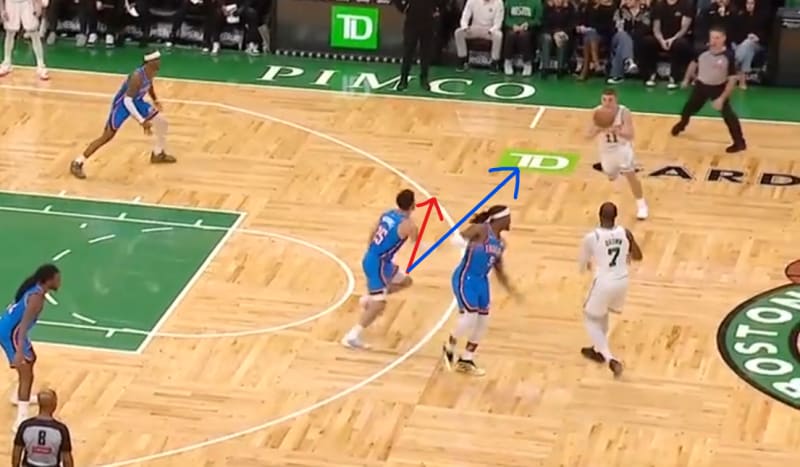
If Pritchard had spaced to the 3-point line, Mitchell’s closeout would have been the red line. But since he was farther back, it was the blue line.
That’s a significant difference.
Mitchell was back at the 3-point line where Pritchard would have been before Pritchard got the shot off. This shot would have been impossible had Pritchard not spaced the floor the way he did.
It’s the same deal with White’s spacing on this play.
Tatum is getting doubled behind the 3-point line. Wallace and Williams are both in his face.
Sam Hausertries to cut under the rim to make Dort guard him, which would leave Gilgeous-Alexander in a two-on-one vs. White and Brown. However, White’s spacing allows him to get an open three regardless of the cut.
He’s so far behind the 3-point line that Gilgeous-Alexander, who was previously guarding Hauser on the wing, doesn’t have time to recover and help Wallace, who was matched up with White.
Again, had White spaced to the 3-point line instead of a few feet behind it, Gilgeous-Alexander would have been able to close out in time. The Thunder could have rotated, and Boston’s advantage would have been erased.
Once again, look at the difference in closeout lines. Red is normal 3-point spacing. Blue is White’s spacing.
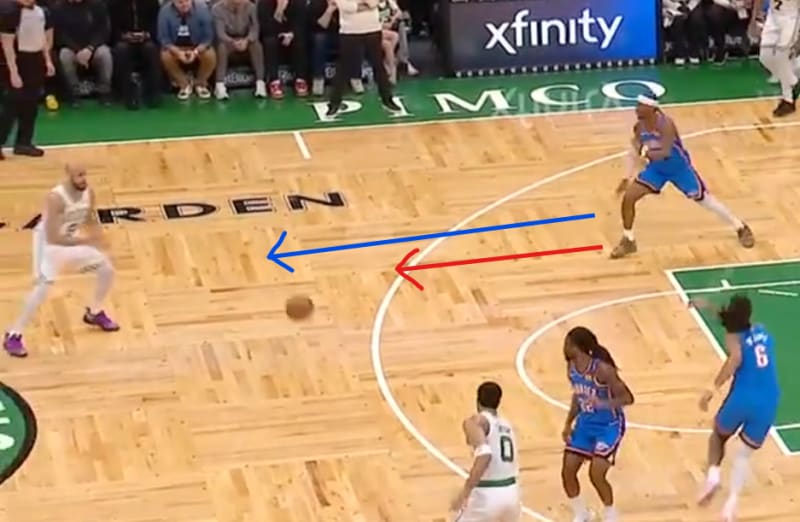
It’s only about a step, but with how quickly White and Pritchard can get off their 3-point shots, that’s more than enough time.
As for Scheierman, since he works out of the corner a lot, his spacing looks a bit different. But it’s just as important.
“Spacing is super important, because that allows you to be open,” Scheierman said. “If the spacing is poor, they're able to double and do it successfully. But when the spacing is right, and you're sliding, you're slashing, it creates open shots for everybody.”
On this play, Scheierman sees the setup. He sees Hartenstein going to help in the paint, and Chet Holmgrenshifting over to guard Queta.
So, rather than staying in the corner, where it could be hard for Brown to thread a pass to (since Holmgren is in the way), he moves up to the wing.
Not only does this give Brown a window to pass through, but it also makes Holmgren’s closeout longer. Corner threes are the shortest on the court, but that also means defenders don’t have to run as far to contest the shot on a closeout.
Scheierman’s spacing was crucial, and nobody loves when opponents double Brown and Tatum more than he does.
“As a guy like me, you kind of like that, because it opens up shots for you,” he said with a smile. “You know what I mean?”
More: On the topic of spacing, Hauser’s rough start to the night wasn’t pretty, and Mazzulla putting in the combination of Scheierman and Hugo Gonzalezwas the right decision at the time.
But Hauser’s a proven 3-point shooter. He’s always going to keep shooting. And in the second half of Wednesday’s game, he proved why that’s a much-needed element of his game.
5. Guarding SGA
Did the Celtics really succeed in containing Gilgeous-Alexander if he finished the night with 35 points and shot 10-of-12 from the field and the free-throw line? Not really.
Did they contain him enough to win the game? Absolutely.
Boston threw double teams at Gilgeous-Alexander from the moment the game started. And at the beginning of the night, that left Dort room to punish them.
On this play, the Celtics triple-teamed Gilgeous-Alexander. It’s less than one minute into the game, and Boston is already throwing three guys at OKC’s superstar.
Dort ended the night shooting 4-of-6 from deep range, but as the game went on, Boston turned its attention to a different player. A new option to help off instead of Dort.
Caruso.
Time and time again, the Celtics doubled Gilgeous-Alexander, leaving Caruso acres of real estate behind the 3-point arc. He shot 1-of-8 from deep range on the night.
On most plays, Boston had its big man guarding Caruso so he could stay sunk into the paint. They were willing to live with Caruso shooting threes.
It paid off. Caruso failed to make the Celtics pay for their defensive decisions, and Boston was able to better pressure Gilgeous-Alexander because of it. But that’s always a dangerous path to take.
What if Caruso had made the shots? What if he shot 4-of-8 instead of 1-of-8? It could have been a completely different ballgame. He’s an NBA player, after all. He can shoot, even if his percentage this season disagrees.
On March 12, in the Celtics’ 104-102 loss to the Thunder, they lived with single coverage on Gilgeous-Alexander down the stretch. He shot 7-of-8 from the field in the fourth quarter, leading OKC to a win.
On Wednesday night, Boston tried to take the power out of his hands.
He (technically) only took one shot attempt in the fourth quarter, but he did take six free throws (he took none in the fourth on March 12). All six of Gilgeous-Alexander’s fourth-quarter free-throw attempts came with 4:07 or less remaining in the game, too.
One of his three trips to the line came in transition. The other two trips actually were one-on-one coverage situations, and both were questionable calls against White (who was unhappy with both of them).
But other than his one make and those three trips to the line, Boston kept Gilgeous-Alexander under control. Or at least as much as a team can possibly contain the soon-to-be two-time MVP.
Look at how many bodies the Celtics showed him on this play (which ended in a Dort banked three).
Boston wanted to take the ball away from Gilgeous-Alexander.
But as the game ticked down, the Celtics did live with some single coverage, just as they did on March 12. Brown took on the matchup here, and he did a great job of forcing Gilgeous-Alexander to give up the ball.
He stood his ground, stuck with Gilgeous-Alexander, and most importantly, didn’t foul.
There is no stopping Gilgeous-Alexander. But the Celtics found a way to limit his impact just enough to get a win.
6. Baylor Scheierman’s highlight
As Scheierman walked through a crowd of reporters postgame, getting ready for his press locker-room interview, a voice rang out from behind the crowd, mimicking (or perhaps mocking) what the first question could be:
“Have you ever had a putback dunk before?”
It was White, who delivered from his locker.
Even Ron Harper Jr. got in on the fun, standing alongside the reporters as Scheierman gave his interview. Scheierman either didn’t see him or did a great job of keeping a straight face as his teammate attempted to crash his interview.
Regardless, White’s question was certainly a relevant one. Because Scheierman’s putback dunk on Wednesday night was certainly worthy of attention.
Scheierman had been on fire all night, making big-time play after big-time play. Obviously, his stepback three over Gilgeous-Alexander was impressive, but perhaps even more impressive was his defensive stand against the Thunder superstar.
And this came right after Scheierman’s step-back three, too. So, at that point, the crowd was rowdy.
There may be nobody on the Celtics better at creating momentum than Scheierman. At least, not when it comes to making a string of plays one after the other.
Scheierman finished the night with 11 points, five rebounds, and one assist on 4-of-8 shooting from the field and 3-of-7 shooting from deep, but as per usual, his impact stretched beyond the box score.
-drives-to-the-basket-during-the-first-half-against-the-toronto-raptors-at-td-garden.-mandatory-credit-paul-rutherfo-(24)-(2)-1.png)