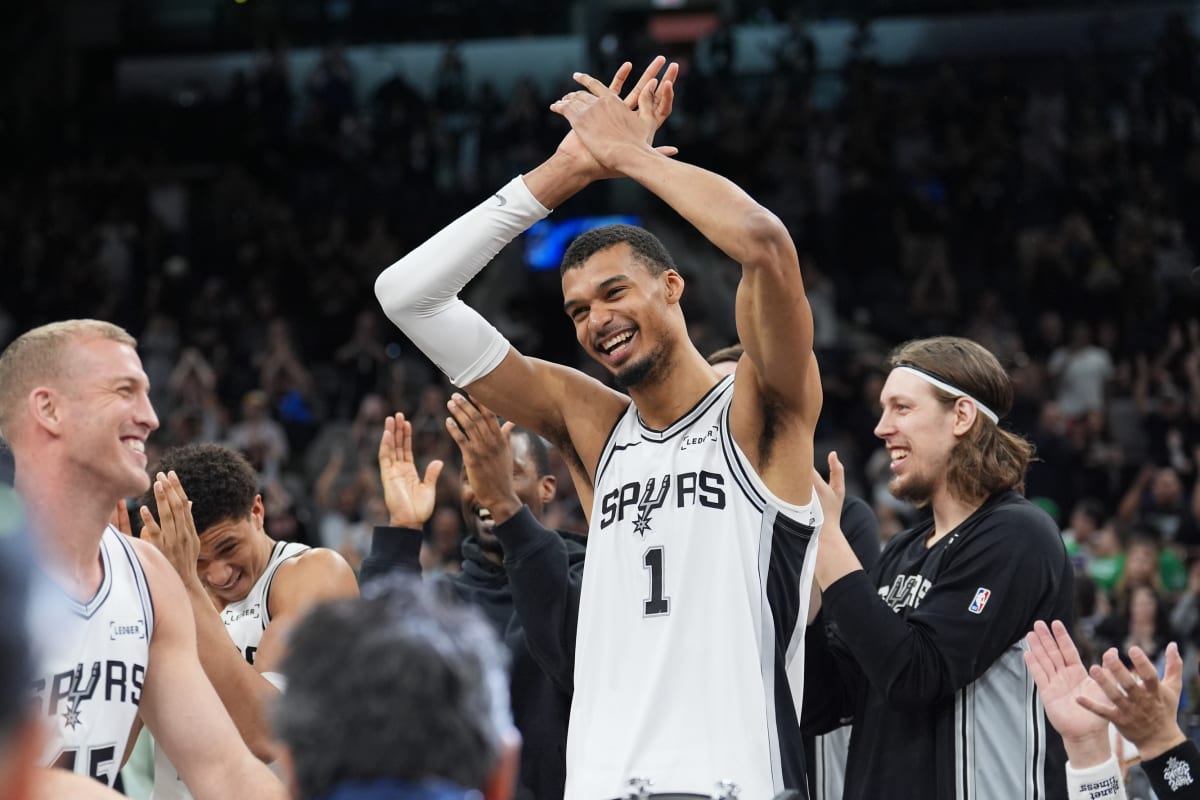

On Tuesday night, the Boston Celtics let Victor Wembanyamashoot 15 threes. He made eight of them. The San Antonio Spurs won 125-116.
Obviously, more went into the game than Boston’s decision to let Wembanyama shoot. Payton Pritchard and Nikola Vucevic were out. Jaylen Brown got ejected late in the second quarter. The Spurs played great basketball—they’re one of the best teams in the NBA for a reason.
But at the end of the day, Joe Mazzulla’s game plan to let Wembanyama shoot from deep range was central to the outcome of the contest.
So, that just leaves one question: Why?
Why did the Celtics let Wembanyama shoot? Why would they give him space from behind the arc? Why didn’t they close out harder in an attempt to try to make him uncomfortable?
To put it simply: The Celtics wanted to turn one of the NBA’s most dominant interior threats into a three-point shooter, in hopes of keeping him out of the paint.
When phrased like that, the plan makes a bit more sense. Though it looked weird in the moment, it’s a sound concept.
‘Keep Wembanyama out of the paint at all costs.’
And more importantly, Mazzulla was playing the math. By the numbers, forcing Wembanyama to operate primarily behind the three-point line gave the Celtics’ defense a mathematical advantage.
Heading into Tuesday night, Wembanyama was shooting 57.7% from two-point range and 35.0% from beyond the arc.
Using those numbers, Wembanyama was scoring 115.4 points for every 100 two-point shots he took. Meanwhile, he was scoring just 105 points for every 100 three-point shots he took.
The math:
100 x .577 = 57.7
57.7 x 2 = 115.4
vs.
100 x .35 = 35
35 x 3 = 105
Immediately, by limiting Wembanyama’s two-point attempts, the Celtics gained a small advantage. But there’s even more of an advantage to the strategy than that.
If you want to listen to this breakdown with video clips included, here's a short video on the subject:
This is why the Celtics let Victor Wembanyama shoot 15 threes pic.twitter.com/MzoamS79s4— Jack Simone (@JackSimoneNBA) March 11, 2026
Keeping Wembanyama out of the paint also limited his ability to get to the free-throw line. He still took 12 against the Celtics, but whenever they gave him space to shoot, it was one less opportunity for him to draw a foul inside.
His height and wingspan give him an inherent advantage in the lane, because most defenders aren’t big enough to get to the ball when he raises it above his head. Thus, he draws fouls more easily.
On top of that, by forcing Wembanyama into acting as a three-point shooter, Boston limited his passing game. If he can’t drive, he can’t draw double-teams, and he can’t kick out to open shooters.
Plus, steering Wembanyama away from the paint by making him shoot threes kept him out of the mix for a lot of offensive rebounds. He’s so tall that he inevitably impacts the offensive glass nearly every possession when he’s in the paint.
Boston was playing an advantage game. They believed their best chance of defeating Wembanyama was to take away what he was best at, forcing him to beat them in a different way.
And by the math, it could have worked.
Wembanyama was shooting 35.0% heading into the game. That means, according to the math, he makes roughly 5.25 of every 15 threes he takes (the number of attempts he took on Tuesday night).
So, by those calculations, Wembanyama made three more triples than the expected numbers indicated. Three threes is nine points.
The Celtics lost by nine.
And that’s without even considering the deeper-level statistics behind Wembanyama’s three-point shooting.
On social media, there was a consistent call-out:
‘Well, of course, Wembanyama is going to shoot better than he does on average. He was open! He shoots better when he’s wide-open!’
As a blanket statement, that makes sense. But in reality, it’s flat-out false.
So far this year, even including Tuesday night’s monster showing from beyond the arc, Wembanyama is a worse three-point shooter when he’s uncovered.
On wide-open threes this season (which is when the closest defender is further than six feet away), Wembanyama has shot 37-of-113 (32.7%).
On open threes this season (which is when the closest defender is 4-6 feet away), Wembanyama has shot 47-of-125 (37.6%).
On tightly-contested threes this season (which is when the defender is 2-4 feet away), Wembanyama has shot 10-of-23 (43.5%).
To break that down more simply:
Wembanyama when wide open: 32.7%
Wembanyama when open: 37.6%
Wembanyama when contested: 43.5%
He is a better shooter when contested than when he’s open.
And if you take away the shots Boston gave up on Tuesday, Wembanyama was shooting 33-of-104 (31.7%) on wide-open three-point attempts this year.
Not only were the Celtics playing smart by the numbers, but they were literally giving Wembanyama the threes that he has been the worst at shooting all season long.
There is no exact science in the NBA. Every time two teams step onto the floor, a game of give-and-take ensues. And when it comes to the NBA’s brightest superstars, the game is taken to another level.
Nikola Jokic’spassing makes him special. So, a lot of teams live with guarding him in single coverage, hoping to take away his playmaking.
James Hardenis elite at getting to his left and drawing fouls on threes. So, some teams give him drives to the right, and once he gets to his step-back, they don’t close out very hard, so he can’t draw a foul.
Luka Doncicis incredible at getting himself to the free-throw line, so teams will avoid fouling him, and if he misses, they run in transition. Doncic doesn’t get back on defense very quickly, so they give some easy buckets in order to take transition opportunities.
Give. Take. Give. Take.
Wembanyama is at that level. He’s a top-five player in the NBA. The Celtics were always going to have to give something. They just had to hope they could take more than they could give.
Unfortunately, Wembanyama had the best three-point shooting night of his life. He set career-highs in attempts and makes.
Boston lost its game of give-and-take on Tuesday night.
The process was smart. But the eye test was ugly, and the results didn’t match the process.
But the math made sense.
-drives-to-the-basket-during-the-first-half-against-the-toronto-raptors-at-td-garden.-mandatory-credit-paul-rutherfo-(24)-(2)-1.png)