
At this time last year, I wrote about what the realistic expectations should be on how much the Patriots would spend during the 2025 offseason.
Turns out, I wasn't far off.
The Patriots had $120 million in cap space to start the offseason, and I said I'd be shocked if they used $100 million. They used about $75 million of it, which allowed them to roll over about $47 million for this offseason. They needed it because, currently, they have about $40 million in cap space, which is the 11th-most in the league.
I also had them with a cash budget for the offseason (on top of the cash already spent), of approximately $160 million. The Patriots ended up spending $174 million cash in Mike Vrabel's first offseason.
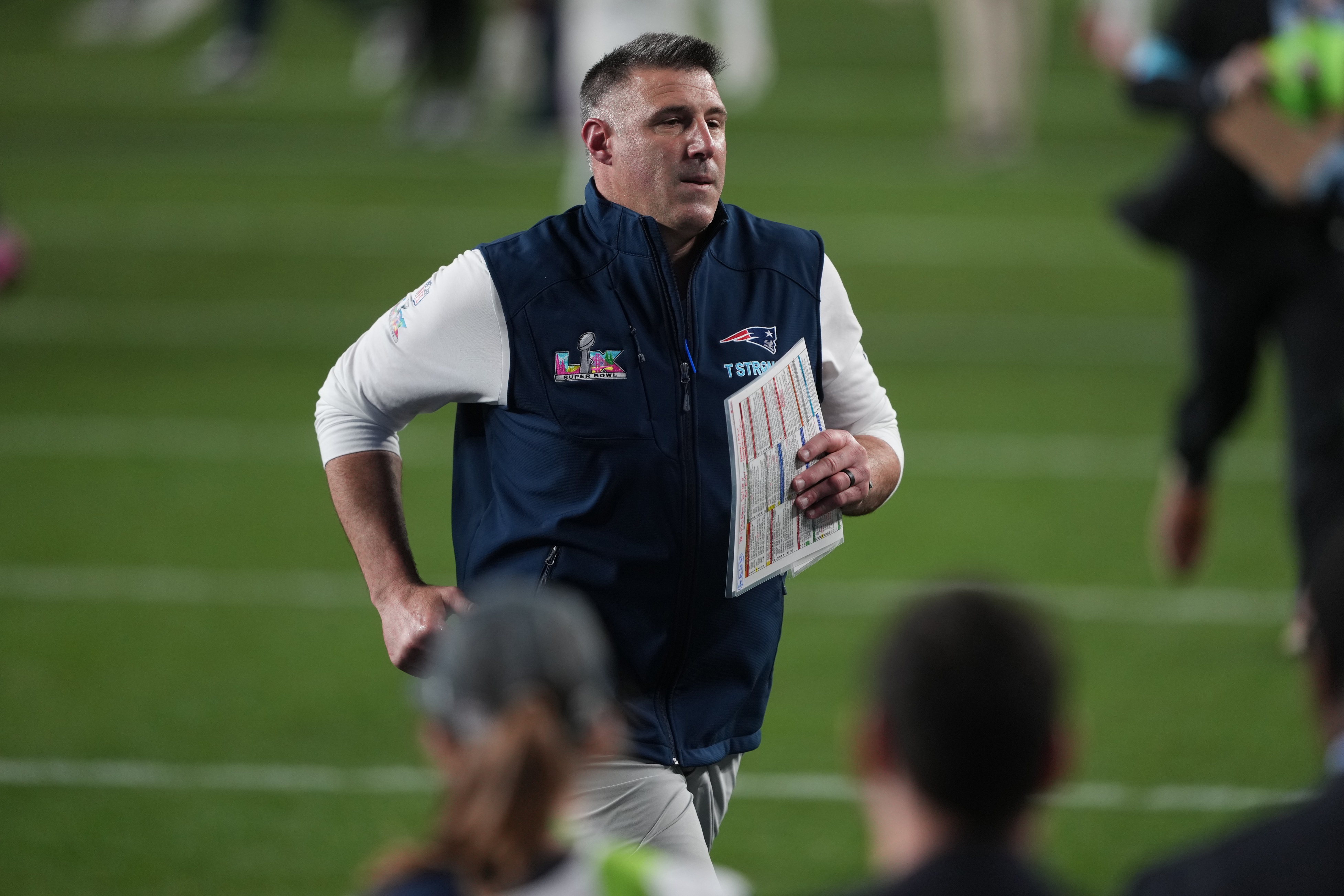
So now the question is, coming off a Super Bowl appearance, how much should we anticipate the Patriots spending in 2026, and how will they allocate those resources — are they going to "go for it," or are they going to stay the course with the rebuild?
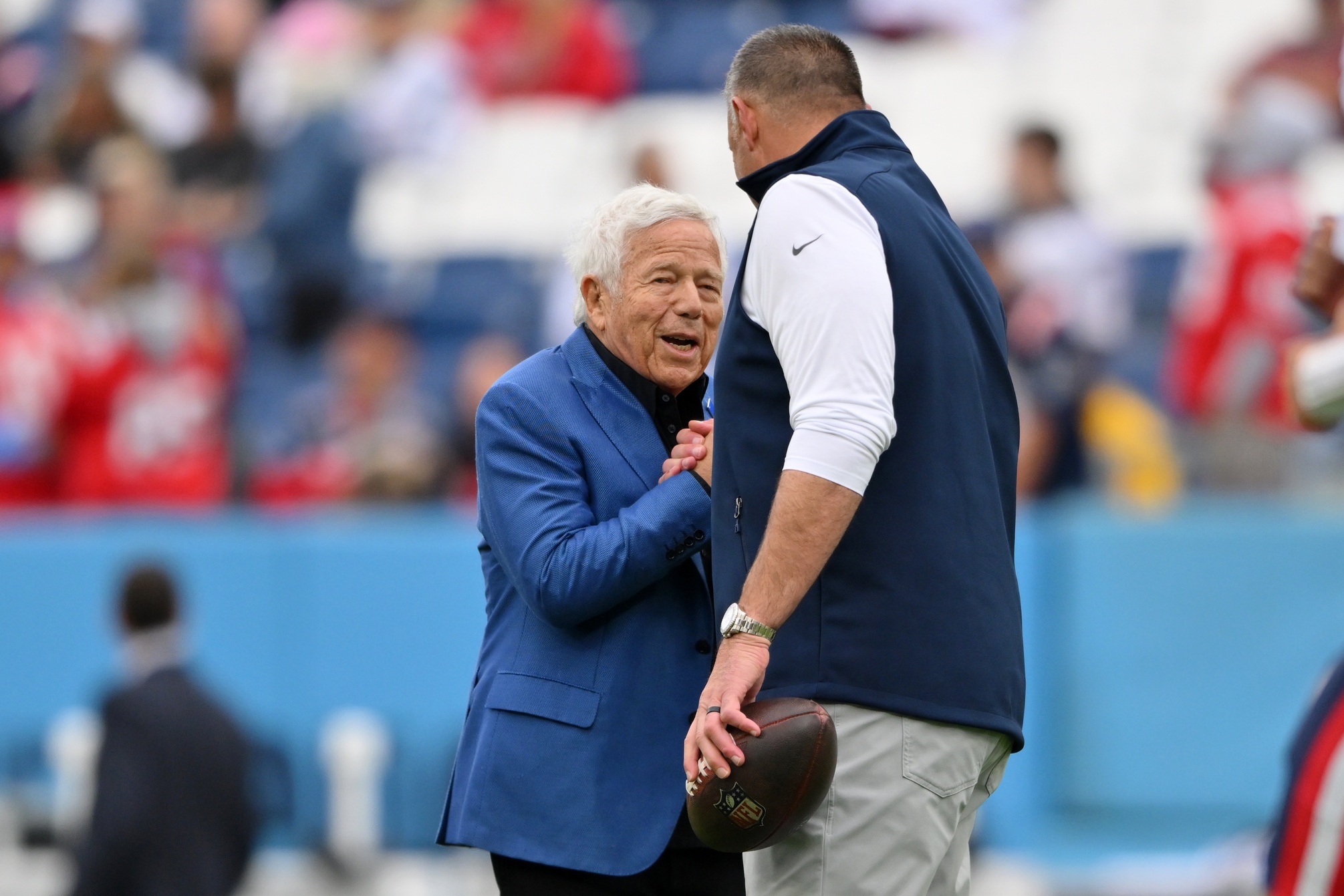
The short answer: Unless Robert Kraftsuddenly turns over a new leaf (it's possible, for reasons I'll get into), I would not anticipate the Patriots spending all that much.
Why? The same answer I had last season: forget cap space — in fact, stop counting cap space — and follow the cash.
The Patriots just spent a ton of cash the previous two seasons.
Counting cap space is the wrong way to track personnel moves by NFL teams. What you want to do is count the cashthe Patriots lay out as they go along. That is the ONLY factor. Cash and cap are not the same. Cap space can be manipulated any way you want. You can use a ton now. You can push some down the road.
Cash is the only real thing to owners, especially to the Krafts, who are businessmen first. Every business has a budget, even sports teams. The Krafts use the cap as a guide to their budget each year. It's called being a cash-to-cap team. How do we know this? Well, we've reported it for years, but Robert Kraftconfirmed it when he answered my question after Jerod Mayo was fired last January.
Q: Robert, this is going to be very expensive. Buying out a coaching staff, bringing in a new coaching staff, perhaps it goes into the personnel department as well. You also have $120 million in cap space this year, the most in the league. Will what you spend on this transition affect anything that you spend on players this offseason?
RKK: The answer is no. We've always had a situation where we spend to the cap. We have never told any coach or limited the spending. The only thing we've said is if you exceed the cap, we'd like to see it leveled out over three years so that we never get way out of hand. But spending to the cap or above the cap is not ... we want to win. That's our priority first.
So what does that mean for the team's spending? It gives us a good road map for how the team will spend going forward.
I'm not going to get into the argument about whether or not the Krafts are cheap. You can throw out the fact that the Patriots ranked last in the NFL over a 10-year period, but that doesn't tell you everything. Bill Belichick, the man who balked at paying a left tackle in Cleveland more than himself before he posted a winning record, was in charge of much of that. And it also says something about how the Patriots didn't have much drafted internal talent worthy of big-money extensions that most teams use their cash on. Let's also not forget that those 10 years include four years of Cam Newton and Mac Jones at quarterback making nothing. That is going to skew the numbers, which is why there is a $30 million per year difference between the Patriots and No. 1 cash king Eagles (who laid out two huge QB deals for Carson Wentz and Jalen Hurtsduring that time, by the way).
(Also, I'm going to point out that the Patriots ranked 17th in cash-over-cap spending from 2015-19, Brady’s final five seasons with the team.)
I'm going to deal with the recent reality, and that paints a picture of the Patriots basically being in the middle of the league when it comes to cash spending - and I expect them to stay in that area. That's not a bad thing, and neither is being a cash-to-cap team, no matter what talk show hosts say about it.
A lot of people think the Patriots didn't spend much money in 2024 and 2025, and used their cap space ($34.9 million rolled over for 2025, $47 million rolled over into 2026) as evidence. Again, that's the wrong way to look at it. The Patriots did indeed "burn some cash" the last two offseasons, as they were 12th in the league in cash spending in 2024, and ninth in 2025.
One thing we don't have worry about this offseason, when it comes to the Patriots' spending: the CBA-mandated 90% cap/cash spending floor (teams have to spend 90% of the cap every three years in cash, or else they have to write a check for the balance to the NFLPA). The Patriots are already $60 million beyond that threshold without spending another cent.
WHY 'THREE YEARS' IS IMPORTANT TO THE KRAFTS
I don't know this for a fact, but it sure seems like Kraft looks in three-year increments because that's what the CBA lays out in terms of the 90% cap/cash spending floor. The 2026 league year is the final year of this three-year period.
Why is that important when it comes to the Patriots' spending? Because we can use the previous three-year period, 2021-23, as a blueprint for how much to expect out of the Patriots as far as spending.
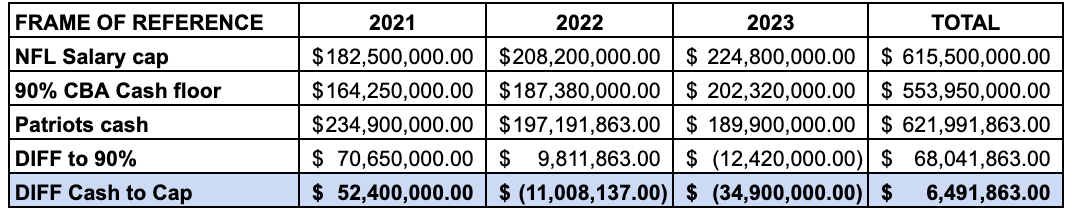
We all know that 2021 was the great Patriots free agent bonanza where they spent on a ton of free agents, including Matthew Judon, Jonnu Smith and Hunter Henryto make up for Belichick's poor drafting.
As you can see on the bottom line, Belichick spent $52.4 million over his budget in 2021. Like Kraft said, Belichick smoothed out the spending over the next two years relative to the cap to the tune of about $45 million. After that three-year period, the Patriots had spent $6.5 million over the cap.
WHAT DOES THAT MEAN FOR 2026?
Where do the Patriots stand after two years of this three-year period?
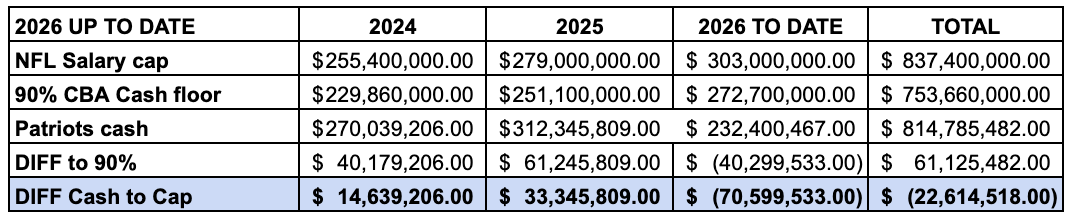
The Patriots have spent $48 million in cash over the cap the past two seasons — basically the equivalent of Belichick's 2021 spending spree spread over two seasons. We saw what happened after that. Kraft wanted the spending balanced out, and he got it.
If Kraft tells Vrabel the same thing, this is what I see:

Kraft gave Belichick about $6.5 million in additional room when all was said and done. Let's say Kraft gives Vrabel about $10 million in additional room. That would mean they only have about $33 million additional cash to spend this offseason. That does not go very far. If Christian Gonzalez gets an extension similar to Derek Stingley, that means Gonzalez would receive about a $25 million cash signing bonus. The offseason would basically consist of relying on the draft.
WHY THE PATRIOTS MIGHT HAVE MORE TO SPEND
It doesn't have to be all doom and gloom, for a couple of different reasons.
1. Kraft could say screw it.
We're guessing Kraft loved being back in the big game, and all the positive attention he got this season after firing Jerod Mayo after one season and hiring Vrabel. I'm sure he was fetted all week in San Francisco, and that will continue this offseason at the league meetings. To keep the good vibes going, he might tell Vrabel he has the green light for another offseason, screw the budgets.
Also, maybe Vrabel earned the trust. Remember how many times Kraft has referenced the 2021 spending, and how little they got out of it? Well, Vrabel got great bang for RKK's buck with his spending. Kraft might tell Vrabel, 'You earned it, keep doing what you're doing. Spend what you need to.'
Also, Kraft got very close to the Hall of Fame this year. Considering the back and forth with Belichick, couldn't you see Kraft wanting to press forward out of spite? How great would it be, in his eyes, if he joined Tom Brady in proving that they could win Super Bowls without Belichick? Ego and spite know no bounds.
2. Remember the cash injection.
The Krafts pounced on the rule change that allowed owners to sell shares of their team to private equity, by selling 8% of the team to two different groups in the fall. That put about $720 million cash directly into the Krafts' pockets. They've done their fair share of cash burning in recent years — the lighthouse, hiring/firing Mayo's staff, hiring Vrabel and his staff (plus a lot more staffers/front office types), and the new practice facility — so I'm sure a bulk of it went there, and other Gillette Stadium improvements.
But maybe there's a leftover $100-$200 million burning a hole in Kraft's pocket, and he gives it to Vrabel to do what he wants as a reward for 2025.
3. Patriots can create more cash with departures.
The cap can work both ways for fans. They got frustrated by seeing all the cap space the Patriots didn't use the two previous offseason. Well, now they pound the cash over cap narrative this offseason because if the Patriots decide to move on from some veteran players, the resulting cap hit(s) are not going to matter — you can easily create cap space with accounting maneuvers, like paying players in bonuses instead of base pay, and adding void years to contracts.
What is going to matter is the cash they free up.
Here's a list of players, and the cash they would open up if they were shown the door:
Stefon Diggs $23 million cash Mike Onwenu $17.5 million cash Christian Barmore $17 million cash Harold Landry $13 million cash (but $11 million is guaranteed, so he would have to be traded) Morgan Moses $8 million cash Garrett Bradbury $5 million cash
Grand total: $83.5 million in cash possibly freed up.
Of course, you have to replace those players. But if most are done internally or via the draft, that would still allow the Patriots to add two or three impact players (take your pick among receiver, edge, left guard and tight end).
WHAT I THINK WILL HAPPEN
I think you're going to see a balance between cutting back on spending, Kraft allowing more leeway with the budget, and the departure of some players to give the Patriots somewhere in the vicinity of $50-60 million in cash to spend this offseason.
It's not a lot compared to last year, but I think Vrabel had this plan in mind. I think he convinced Kraft to let him spend in 2025 in order to get competitive quickly. If that happened, they would bid some veterans goodbye, concentrate on the draft and internal improvement, free agency would mostly be on a budget, and with one or two big-ticket items in 2026. The Patriots didn't make a trade deadline deal or part with any draft picks for a reason. They also stashed youngers on the 53-man roster like ED Bradyn Swinson (27 snaps), TE DJ Dippre (20) and CB Kobee Minor (39) instead of bringing in veteran depth for a reason.
They knew the path to the Patriots being a sustainable winner was not going to happen overnight, Super Bowl berth or no Super Bowl berth.