
The Patriots decided to reshape their safety room this offseason, walking away from a culture-setter in Jaylinn Hawkins for someone who helped define Mike Vrabel’s Titans teams in Kevin Byard. That there is a five-year age difference between the two certainly should raise an eyebrow or two, but Byard is so beloved by all the Tennessee castoffs now situated in Foxborough that, mostly, no one has blinked.
As I wrote at the time of the signing, Byard shouldn’t be as prone to the coverage busts that popped up with Hawkins from time to time. But he also doesn’t run as well, and thrived mostly as a deep safety for the Bears this past season. The Pats have said they like having interchangeable safeties, but perhaps the way Craig Woodson blossomed late in the year, playing more in the box, has changed their thinking, at least for this year.
Don’t get me wrong. It’s not as if Byard can’t play in the box. He still has a nose for the ball (93 tackles last year), but how much do you want to subject his soon-to-be 33-year-old body (his birthday is in August) to pulling guards, or a bigger-bodied tight end? I’d let Woodson handle that more often than not. We’ll see how Zak Kuhrdecides to approach that.
Behind those two, there’s former UDFA Dell Pettus, who they like, recent signee Mike Brown, and, of course, a non-safety safety in Brenden Schooler. Practice-squader John Saunders Jr.also remains on the 90-man roster. So, with Byard's age and perhaps a lack of a suitable long-term solution alongside Woodson, safety is a need. Would Vrabel and company want one on day one? Feels unlikely. After that, the door is open.
TIER ONE: Caleb Downs, OSU (6', 206 lbs); Dillon Thieneman, Oregon (6', 201 lbs); Emmanuel McNeil-Warren, Toledo (6'3.5", 201 lbs)
Downs belongs in a tier of his own, but for my own well-being, I’m coupling this trio. I don’t expect any to end up in NE, so I won’t be spending a ton of time explaining them.
The argument could easily be made that Downs has been the best safety in college football since the day he walked in the door at Alabama. He starred for them, then transferred to Ohio State, and nothing changed except for his NIL paycheck. Positional value - and a knee that was red-flagged for, reportedly, a degenerative ACL - probably has him slipping a little. But when I write that, I’m talking to like 10 overall. Downs is an absolute stud. Tackles well. Covers ground. Covers receivers. Football IQ off the charts. He will start immediately and make an impact.
Thieneman seemed like a late first-rounder, then backed up his terrific season with the Ducks with an eye-popping combine performance. Now he seems to be unlikely to get out of the top 20. He runs well, hits like a truck, and while he’s not Downs, he should start right away. A very instinctive player, always in the middle of everything. To watch Thieneman trigger on a play happening in front of him is a sight to behold.
McNeil-Warren is intriguing. Obviously, Toledo isn’t Alabama or Oregon, but every time he got the opportunity to show out against higher competition, he did. Quite frankly, if you don’t like his tape, we can’t be friends. McNeil-Warren forced eight fumbles over the course of his career, and attacks the ball like few I’ve ever seen. There’s a little stiffness that’s evident when he changes directions, and so man coverage isn’t his best suit, but otherwise, this is a solid player. Stick him closer to the line of scrimmage and let him cook. Should land somewhere between 24 and 32 in round one.
(I just wrote about those 3 more than I told myself I would. Fun group)
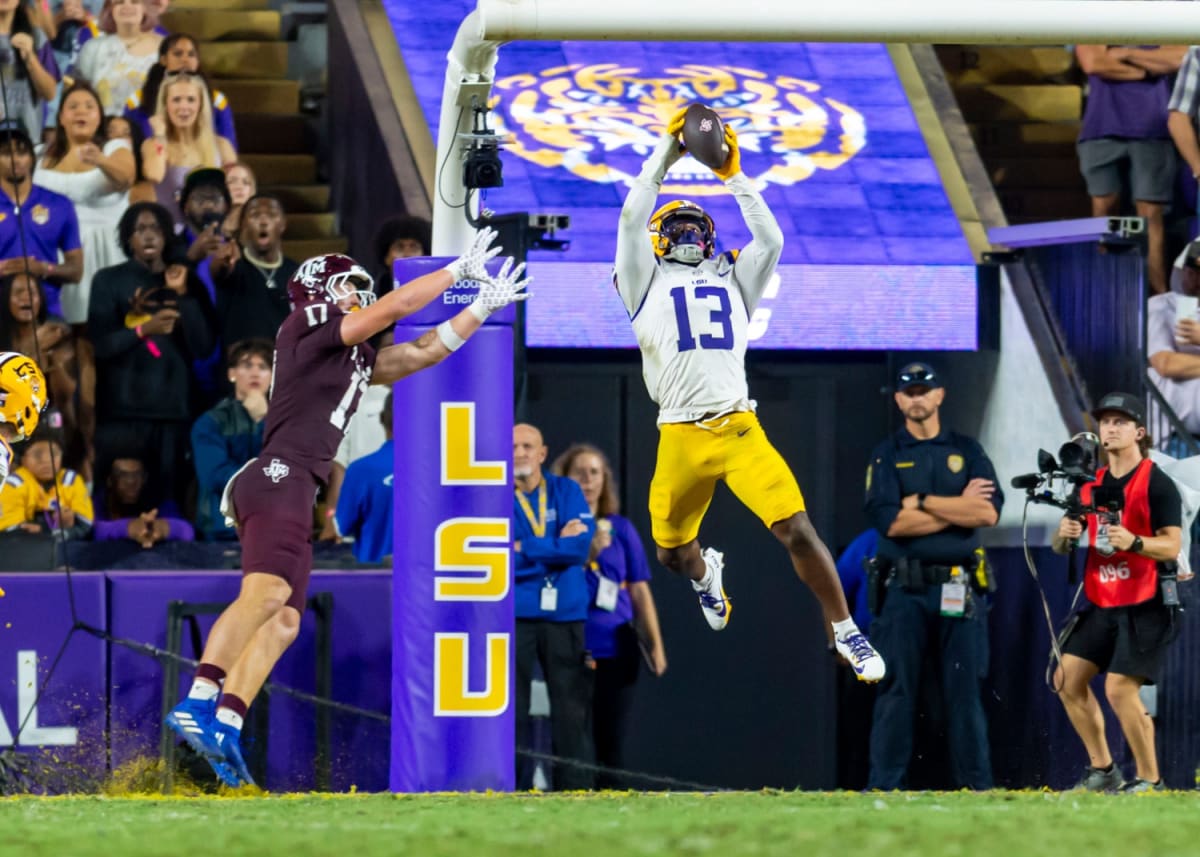
TIER TWO: Treydan Stukes, Arizona (6’1”, 190); A.J. Haulcy, LSU (6'.215 lbs)
For the next 7 or 8 players, there is no consensus—choosing between them feels like picking your favorite bubble gum: Big Red, Fruit Stripe, Juicy Fruit, Bubbalicious. They're all represented.
I think Haulcy is a first-rounder, too. I might be the only person on that island, but so be it. I am not afraid. His nickname in high school was “Mr. Give Me That” because of his penchant for creating turnovers. Haulcy is still that guy.
Cut some weight for the combine (so he could run a 4.52 40), but plays at around 220 and is a heat-seeking missile and someone whose physicality can change games. Reads routes better than the quarterback who is throwing them (at least, that’s how it feels at times).
“His football IQ is off the charts,” texted one scout. “Knows when to attack the ball and when to attack the receiver.”
Isn’t a consistent tackler, and that may have something to do with shorter arms (they measure ‘em for a reason, folks). Haulcy isn’t a showstopping athlete, though he’s built like one. I don’t see him as a Patriot fit from a scheme perspective, but I can’t help but love what he brings. Maybe it’s the John Lynch/Rodney Harrison/Brian Dawkinsfan-boy in me.
Stukes is an awesome story. A former walk-on and a six-year college player (tore an ACL in 2024) ended up as the team captain. Elite athlete. 4.33 40. 10’10” broad jump. 38” vert. I watch him and see a Byard replacement if we assume Byard is playing free safety a majority of the time. Terrific range, oily hips, and yet plays with violence (as I’m writing this up, he sounds like a first-rounder, too, but that’s not happening).
“Would like to see him see it a little quicker,” said that same scout. “That speed, though, allows him to make up for some of that. Needs to tighten up his tackling. Comes in high and sometimes eats a shoulder pad or helmet because of it.”
TIER THREE: Bud Clark, TCU (6’1”, 188); Keionte Scott, Miami (5’11”, 193)
Clark is a string bean (aside: I wrote "green bean," proofread, didn’t catch it, and then, as I was putting it in the system, it jumped out to me. That, my friends, is where my brain is at). Think Merton Hanks-like. But he runs very well, finds the football (15 career INTs), and seems like he should be a full-time free safety because of that range and how he goes and gets the football. That bites Clark in the ass at times, as he gave up almost as much as he got.
“He’s a hold-on-for-dear-life kind of tackler,” one assistant coach shared with me, “and needs to be less of a risk taker, but at worst, he’s a rotational safety. At best, because of the ball production, he makes a Pro Bowl.”
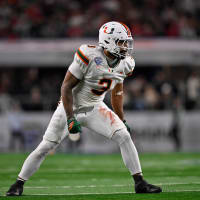
There are plenty of NFL people who think Scott is a nickel corner. I see where they are coming from. That’s what he did mostly for the Hurricanes, and even at that size, he was a physical run defender. Like, kinda blew me away. I have zero worries about how he will fare in that regard. And he tackles like a boss, even at that size.
But if Scott ends up as a cornerback, he’d have his hands full in man coverage because he just doesn’t have that kind of speed. But if the play is in front of him, the kid is on it. Hence, why I kept him at safety. Older (24).
Others of note: Zakee Wheatley, Penn St (6’3”, 203); Genesis Smith, Arizona (6’2”, 202); VJ Payne, Kansas State (6’3”, 206); Louis Moore, Indiana (5’11”, 191); Kamari Ramsey, USC (6’, 202); Jalon Kilgore, South Carolina (6’1”, 210)
There are a couple of potential starters in this group. Payne might end up as a cornerback. His strength is in coverage, and with that height/length, intrigues. He often matched 1-on-1 with tight ends.
“Bet on the traits,” one assistant coach texted me about Payne. “There’s a lot there.”
Wheatley is a zone safety. Solid tackler. Good agility.
How’s this for a scouting report on Moore: not a great athlete, and not physically big, but man, he’s always where he’s supposed to be.